
Spain's ZBE Low Emission Zones in 2026: The American Expat Driver's Survival Guide
Spain's ZBE low emission zones now cover every Spanish city over 50,000 residents. As of January 2025, that includes Barcelona, Madrid, Seville, Valencia, Zaragoza, Málaga, Bilbao, and 70+ others — each with its own camera network, its own sticker rules, and €200 fines for drivers who roll in blind. If you're an American expat driving in Spain in 2026, the question is no longer whether you'll hit a ZBE — it's whether you'll be legal when you do.
🚗 What a ZBE actually does — and why you can't drive blind
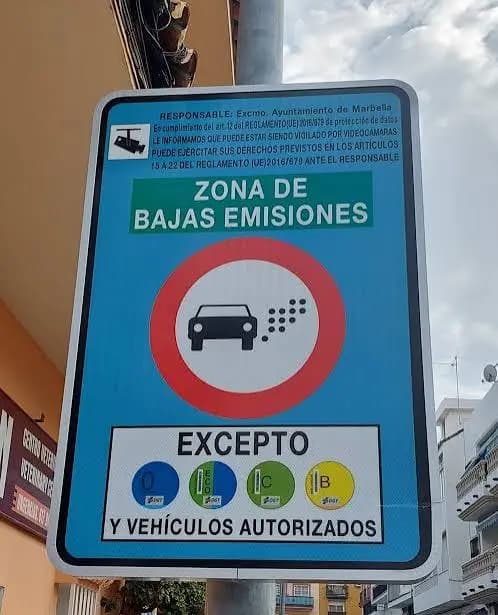
A ZBE (Zona de Bajas Emisiones) is a restricted traffic zone covering, typically, the central district of a Spanish city. Inside it, vehicles that don't meet the city's emissions category are either banned outright or fined on entry. Cameras — fixed at perimeter portals and mobile units — read your license plate and check it against the city's whitelist. No sticker on the windshield isn't a defense. The system has your number.
The legal basis is Real Decreto 1052/2022, which required all Spanish municipalities over 50,000 residents to implement a ZBE by the end of 2023. By 2025, that deadline had been enforced through Spain's national air-quality compliance rules under EU Directive 2008/50/EC — and most cities have been operating live zones ever since. Ignoring them isn't ignorance. It's a €200 fine. Repeat offenders within a year can see that climb to €1,000.
For American expats, the trap is structural: the rules vary city by city, the sticker system is unfamiliar, and rental-car companies rarely tell you which zone you're driving into. You need to know this before you pick up the keys.
Heads up: The €200 fine applies to the driver, not the rental company. The rental firm will be invoiced by the city, then pass the charge — plus an admin fee, often €30–€50 — to your credit card. Some companies also block the rental of non-compliant cars in ZBE cities. Read the fine print.
🏷 The DGT sticker system: 0, ECO, C, B — and which one you need
Spain's Dirección General de Tráfico (DGT) classifies every vehicle by emissions into one of four environmental labels. These are the colored stickers you see on Spanish windshields — and they are the only thing that determines whether you can enter a ZBE.
Action step: Check your car's DGT classification at sede.dgt.gob.es using your Spanish license plate. If you don't have a plate yet, use the European type-approval certificate from your manufacturer. US-spec cars often fall into B or no-sticker categories — see Section 5.
🗺 The 2026 ZBE city map: every major Spanish city covered
As of January 2025, the DGT and the Ministry for Ecological Transition list 151 active ZBEs across Spain. The list below covers the cities most American expats actually drive in. If you live in or visit any of these, the ZBE applies.
Smaller municipalities are still rolling out their own ZBE maps, often with phased timelines through 2026. The full national list is updated quarterly at miteco.gob.es.
💶 Fines, enforcement, and the cameras you can't see
The base fine for entering a ZBE without the right sticker is €200. That is the minimum — and it applies to individual incidents, not annual access. Drive through the same Barcelona ZBE five times in a week without a sticker, and you can rack up €1,000 before the month is out.
Enforcement works through a layered system:
- Fixed ANPR cameras at the perimeter of every ZBE. They read your plate, query the DGT database in milliseconds, and issue an automatic denuncia (penalty notice) if you're not on the access whitelist.
- Mobile ANPR units — vans and motorcycles equipped with the same cameras, deployed unpredictably inside the zone to catch vehicles that have entered through pedestrian or service-only access points.
- Resident reports via the city app. Barcelona's BCN ZBE app, for instance, lets any resident report a suspicious vehicle. The reports feed into the same enforcement pipeline.
Once issued, fines are sent to the registered address of the vehicle. For a Spanish-plated car, that's quick — typically within two weeks. For foreign-plated cars, the city must serve the fine through the rental company or via international treaty (the EU's Eucaris system covers EU plates; for US plates, the city mails to your last known address, which often means the fine catches up with you months later, sometimes in collection).
Critical: A US-spec rental car with no Spanish registration and no DGT sticker is, in practice, invisible to the camera network. That is not a loophole. Most US rental companies that operate in Spain register their fleet with the DGT before delivery — but if you bring your own US-plated car, you must register it before driving in any ZBE. See Section 5.
🇺🇸 The American-expat problem: rental cars, US imports, and TIE registration
Three situations catch American expats in ZBE trouble more than anything else.
Rental cars. Spanish rental fleets are typically Euro 6 petrol or diesel — most post-2020 rentals carry at least a C sticker. The exception is older "economy" fleets and some long-term lease providers that recycle cars in the B category. Always confirm the sticker category when you pick up the car. The contract won't say it; the desk agent may not mention it. Ask: "¿Qué etiqueta ambiental tiene este coche?"
Imported US-spec cars. A vehicle originally sold in the United States often falls into B or no-sticker territory under the DGT classification, because US emissions standards don't map cleanly to Euro 1–6 categories. The car needs to be registered in Spain (getting Spanish plates, matriculación) before you can request a sticker. That process, run by the Jefatura Provincial de Tráfico, can take 8–14 weeks. Until it's done, you cannot legally drive in any major Spanish city.
Long-stay US-plated cars. If you drive a US-plated car into Spain on a tourist or non-resident visa, you can use it for up to 6 months in any 12-month period. After that, the car must be re-exported or matriculated. ZBE rules apply regardless of how long you've had the car. And because US plates are often invisible to Spain's domestic camera database until manual cross-referencing, fines can take months to reach you — usually bundled together when the rental company or the customs authority finally catches up.
If you hold a TIE (the foreign-resident ID card for non-EU citizens), you can register a foreign car in Spain on the same form as any Spanish resident — but you must have a Spanish address (empadronamiento) and the ITV (vehicle inspection) certificate. Plan the timing carefully: registering a US car for ZBE access typically takes 10–16 weeks end-to-end, including ITV scheduling.
Action step: Before driving into any Spanish city, check the city's ZBE access map online (each has one). Madrid: madrid360.es. Barcelona: zbe.barcelona. Seville: zbesevilla.es. They show the boundaries in plain sight — if your route crosses one, you'll know before the camera does.
✅ Pre-flight checklist before driving into a Spanish city in 2026
Pre-flight checklist for ZBE compliance:
- Verify your DGT sticker. Use the DGT online tool or your rental contract. If you have a B sticker, you are not legal in Madrid 360, Barcelona, Seville, or Valencia centro.
- Check the city's ZBE map. Some cities restrict central districts further than the outer ZBE. Madrid 360's central district requires C; the surrounding zone accepts C+.
- Confirm the camera positions. ZBE portals are signposted, but the apps are more accurate. Madrid's Madrid 360 app and Barcelona's BCN ZBE app both show real-time portal locations.
- For foreign-plated cars: Make sure your vehicle is registered with the DGT and has a sticker. If not, you cannot enter the ZBE — even with a valid US driver's license.
- For residents: Apply for a ZBE resident permit through your city's website. Most cities require empadronamiento plus the car registration document. Renewal is annual.
- For deliveries and short visits: Some cities (Madrid included) offer hourly or daily access passes for non-compliant vehicles. They're cheap (typically €3–€5 per day) but limited to a set number per year.
- Keep your ITV certificate in the car. Inspections confirm your Euro category, which is what the DGT uses to issue stickers. If you can't produce it during a roadside check, the fine escalates.
The ZBE rollout isn't slowing down — it's tightening. Cities that started with C+ have moved to ECO-only in central districts, and Madrid has signaled that the next phase (planned for 2027) will restrict access to 0-emission vehicles in the most polluted zones. For an American expat planning a long stay in Spain, the practical move is to buy or lease a vehicle with a C sticker at minimum, and an ECO or 0 if you intend to live in Barcelona, Madrid, or any major city centre. The €200 fine isn't the cost that hurts — it's the cascade of admin fees, rental surcharges, and the mark on your record when the same infraction shows up three months later.
Expatly360 handles NIE applications, TIE renewals, vehicle import paperwork, and the full DGT matriculation sequence for American families relocating to Spain. We coordinate ITV scheduling, ZBE sticker registration, and the DGT traffic-office appointments that come with bringing a US-spec car into compliance. First consultation is free.
Expatly360 helps Americans on every step of driving legally in Spain
📞 +34 673491330 | WhatsApp available
🌐 www.expatly360.com
Recommended for You


Relocating to Spain?
Don't navigate the bureaucracy alone. Our team in Malaga handles everything from NIE to residency permits.
Get Professional Support