
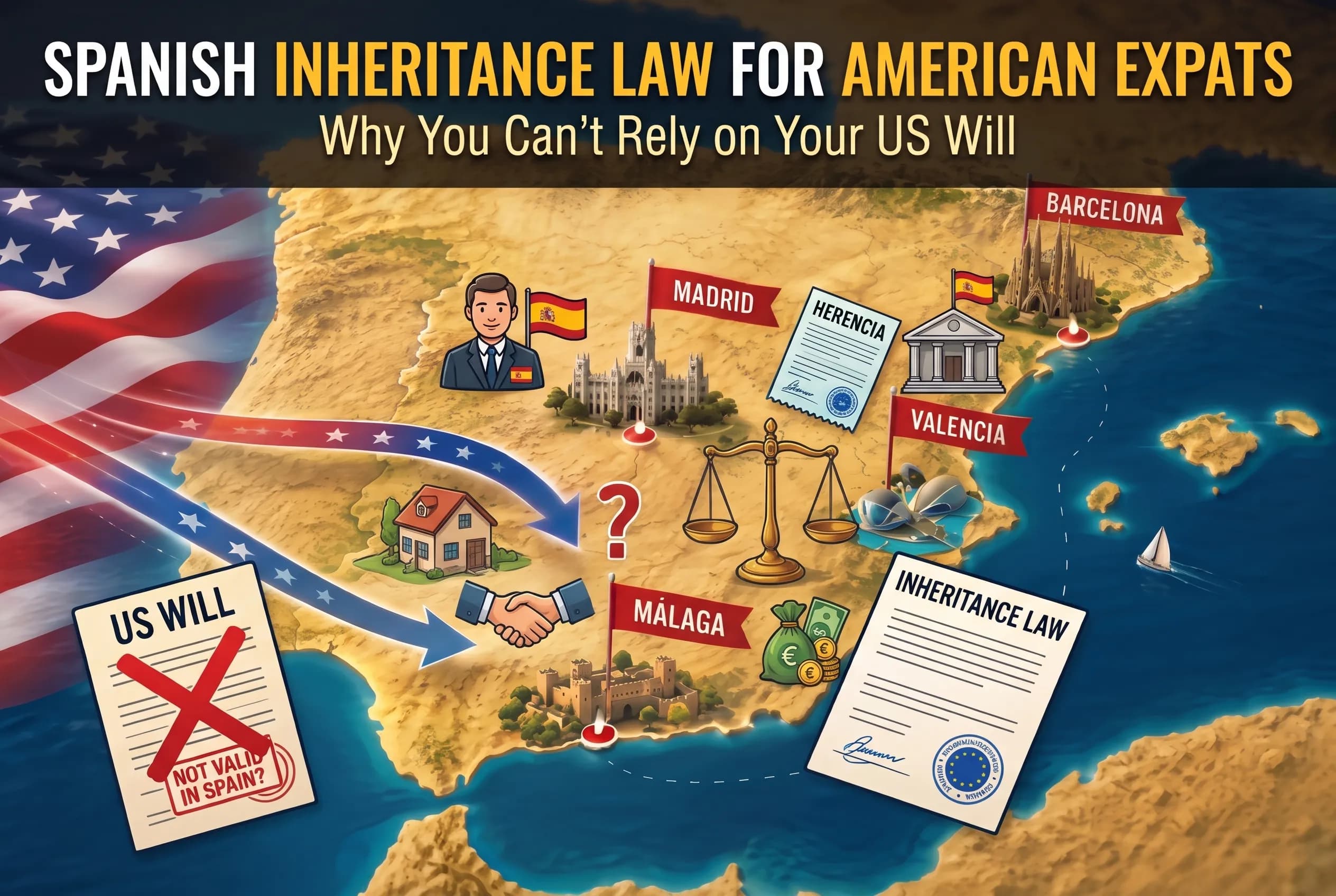
Spanish Inheritance Law for American Expats: Why You Can't Rely on Your US Will
Spain's civil code overrides American wills for any asset located in Spain. Without a separate will executed before a Spanish notary, your Spanish estate falls under intestado — Spanish intestacy — and forced heirship gives your children, parents, and spouse automatic claims that no US will can erase. The cost of a Spanish will with the right EU Succession Regulation clause: €800–900 and one notary visit. The cost of skipping it: 5–15% of estate value and 18–24 months of legal proceedings.
🏛 The Forced Heirship Trap
Spanish succession law is built on a principle that shocks Americans at first read: you do not fully own what you think you own. Article 658 of the Spanish Civil Code reserves two-thirds of every estate for the familia — children first, parents second, spouse alongside the lineal heirs. The remaining third is yours to distribute by testament, but no more.
This is legítima — forced heirship. It applies to every estate that passes under Spanish law, regardless of what the deceased's foreign will says. American expat property owners routinely assume their US will — drafted under freedom-of-disposition, probated in a US surrogate's office, naming an executor and specific bequests — will govern their Spanish house, Marazulla, or Nerja apartment. It will not. The Spanish courts will treat your US will as a foreign document that can only inform the tercio libre, the one-third your free assignment actually controls.
The practical effect: if you have two adult children and you wanted to leave your €500,000 Spanish house to your surviving spouse, then yes — Spanish law allows that for one-third of the estate (tercio libre), but the other two-thirds must go to the children in proportions set by the legítima. Your spouse gets a lifetime right to use one-third of it — not its ownership. This is not what most American families have in mind.
Heads up: Spanish courts have repeatedly ruled that US wills cannot waive Spanish forced heirship for Spanish-situs assets, even when the will expressly invokes freedom-of-disposition. The legítima is a matter of public policy under Spanish law, and a foreign will cannot override it.
📜 What Happens Without a Spanish Will
When an American expat dies owning Spanish property without a Spanish will, three things happen in sequence. None of them are good.
First, the Spanish Registro de Últimas Voluntades (Registry of Last Wills) confirms no Spanish will has been deposited within 15 working days of the death certificate being filed. This is the moment Spanish law takes over the asset distribution. The US will, no matter how carefully drafted, is irrelevant for the Spanish estate.
Second, a Spanish notario is assigned to declare the heirs by operation of law. The notario reads from the Civil Code, not from your will. The heirs are determined by your family structure: spouse + children get their legítima shares; if no children, parents inherit; if no heirs, the estate escheats to the Autonomous Community. This is declaración de herederos abintestato — the formal declaration of intestate heirs.
Third, the heirs now need to: obtain a NIE each (or activate existing), file Modelo 650 (or 651 in some regions) for the inheritance tax, pay the tax, accept the inheritance in a public deed (escritura de aceptación y adjudicación de herencia), and register the new ownership at the Registro de la Propiedad. Each step requires an Apostille and sworn translation of US documents — birth certificates, marriage certificates, US death certificate.
A US will that says "I leave my Spanish house to my spouse" does not bypass this. The spouse inherits their legítima share under Spanish law, and the rest of the estate goes to whoever the Civil Code says — even if your US will says otherwise. For American couples where the spouse is a non-US citizen, the complication is worse: they need a NIE first, which requires a trip to Spain or a Spanish consulate.
Action step: if you already own Spanish property and don't have a Spanish will, treat this as urgent. The gap between owning property and having a Spanish will is the gap between 1% probate friction and 15% estate destruction. Schedule a notary appointment within the next 30 days.
🇪🇺 EU Succession Regulation 650/2012 — Your Escape Hatch
There is one tool that fixes this, and Americans routinely don't know it exists: EU Succession Regulation 650/2012. In effect since August 2015, this regulation governs cross-border inheritance across all EU member states (the UK left with Brexit, so the regulation does not apply there).
The default rule is harsh: lex domicilii — the law of your habitual residence at the time of death governs your estate. For an American expat living in Spain on a TIE (long-term residency), that's Spanish law, and the legítima applies.
The good news: Article 22 of the Regulation allows you to choose the law of any nationality you hold to govern your estate as a whole. If you're American, you can choose the law of California, Texas, Florida — any US state, actually, since the US doesn't have federal succession law and individual states do. This is the professio iuris — the choice-of-law clause.
Two requirements, both strict:
1. The choice must be made expressly in a will. No tacit election, no "I always intended" — the notario needs an explicit clause naming the chosen law. "I choose the law of California to govern my estate" is the test phrase; not "I would prefer US law."
2. The will must be a formal testamento: signed before a Spanish notario, or a foreign public deed that gets apostilled and registered with the Spanish notario registry. A handwritten will (testamento ológrafo) is not sufficient for the choice-of-law clause.
The effect: if you've chosen California law and your Spanish will says "my Spanish property goes to my spouse under California testamentary freedom," the Spanish court will apply California law. Spanish legítima does not apply because the estate is governed by the law you chose. The Spanish court will recognize the will as written.
Heads up: EU Succession Regulation 650/2012 applies to the entire estate as a single mass. You cannot split it — choose US law for your Spanish house and Spanish law for your Spanish bank account. It's all-or-nothing. If your US state has forced heirship (Louisiana, for example), you inherit that problem by choosing Louisiana law. Pick a state with full testamentary freedom: California, Texas, Florida, New York, Washington.
💰 Spanish Inheritance Tax for Americans
Spain charges inheritance tax (Impuesto sobre Sucesiones y Donaciones, ISD) on every estate that passes under Spanish law — which, as of EU Succession Regulation 650/2012, includes Spanish-situs assets regardless of the deceased's nationality. The tax is regional, which is why an estate worth €500,000 costs dramatically more in Catalonia than in Andalucía.
Andalucía — where most American expats own property along the Costa del Sol, Costa de la Luz, and Costa Tropical — is the most expat-friendly inheritance tax regime in the country. A spouse inheriting from another spouse pays effectively 0% ISD after the regional 99% reduction. Adult children pay between 7.65% and 13% depending on the pre-existing wealth and the size of the inheritance.
The brutal fact most Americans don't realize: there is no US-Spain estate tax treaty. Unlike the Netherlands-US (1969), France-US (1978), Germany-US, Italy-US, and other bilateral estate tax treaties, the US and Spain have no comprehensive agreement to avoid double taxation on estates. The current US administration has not negotiated one. The result: if your estate crosses the US federal estate tax threshold ($13.66 million per individual in 2026, dropping to ~$7 million post-2025 sunset absent Congressional action), you may pay BOTH Spanish ISD AND US federal estate tax on the same assets.
For American expats with estates below the federal threshold, Spanish ISD is the only inheritance tax. Above the threshold, a foreign death tax credit (Form 706) lets you claim Spanish ISD as a credit against US estate tax, but only on the portion of the estate that's Spanish-situs. The mechanics are brutal enough that professional advice is non-negotiable.
Heads up: if your estate is over $5M and includes both US and Spanish assets, you need a cross-border estate planner — not a Spanish abogado, not a US estate attorney alone. The interaction of US estate tax, state inheritance tax, Spanish ISD, and the missing bilateral treaty creates traps that single-jurisdiction professionals routinely miss. Budget $5,000–15,000 for the planning, save $50,000+ in tax.
📋 Step-by-Step: Get a Spanish Will Right
Pre-flight checklist:
- Hire an abogado specializing in international succession — not a general-practice lawyer. Look for membership in the Asociación Española de Abogados de Familia or equivalent international succession practice. Initial consultation: €200–400.
- Bring to the first meeting: passport, NIE, deeds to any Spanish property, existing US will, marriage certificate, birth certificates of children, list of all Spanish bank accounts and Spanish-situs investments.
- Decide your choice-of-law clause: under EU Succession Regulation 650/2012, will your Spanish will invoke the law of California (or your home state) or Spanish law? Your abogado will explain the trade-offs, but the default for Americans is US law for full testamentary freedom.
- Book a Spanish notario. The will is signed at the notario's office with two adult witnesses present. Cost: €200–400 for the will itself, plus €60–100 for notario registry filing.
- Sign the will. The notary records it in the Registro de Últimas Voluntades so future Spanish authorities can locate it within 15 working days of death certificate filing.
- Update the will every 5 years or after major life changes: marriage, divorce, new Spanish property acquisition, birth of children or grandchildren, change of US domicile, change in inheritance tax residence.
The total cost: €600–900 for the abogado + notario, plus €100–200 for Apostille and sworn translation of supporting US documents if those need updating. For an estate worth €500,000, this is a one-time cost of 0.2% — versus 5–15% in intestacy costs and inheritance tax friction. The math is not subtle.
Action step: if you already own Spanish property and have a Spanish will that's more than 5 years old, schedule a review. EU Succession Regulation 650/2012 has been in force for over a decade, but most American expat wills executed before 2015 didn't include the choice-of-law clause. Without it, you're back to Spanish legítima by default.
⚠️ What Can Go Wrong
Mistake 1: Relying on your US will alone. Your US will is a beautifully drafted document that means nothing for Spanish-situs assets without a Spanish will with the choice-of-law clause. Spanish courts will not honor a US will that purports to dispose of Spanish property under freedom-of-disposition.
Mistake 2: Not updating after property purchase. Many American expats get a Spanish will when they buy their first Spanish property, then buy a second property and never update the will. The will must reference all current Spanish-situs assets or use a generic "all my Spanish property" clause. Get the language right.
Mistake 3: Forgetting stepchildren or non-marital partners. Spanish legítima protects biological and adopted children, but not stepchildren (unless formally adopted) or unmarried partners (unless registered as pareja de hecho). If your Spanish estate goes through intestacy, your US-style blended family arrangements are not recognized.
Mistake 4: Joint ownership with the wrong structure. Many American expats buy Spanish property jointly with their spouse or with siblings using "pro indiviso" (undivided shares). If one joint owner dies, the survivor inherits the deceased's share by operation of law under the declaración de herederos — but ONLY if the survivor is the spouse under Spanish law. Otherwise, all joint owners' shares go through full inheritance proceedings.
Mistake 5: Using an online "Spanish will" template. Templates circulating online are not legal advice, not notarized, and not registered in the Spanish Registry of Last Wills. They have no more legal force than a draft on a napkin. A €200 notary fee is the difference between a will that works and one that doesn't.
Mistake 6: Waiting until the property purchase is final. The best moment to execute a Spanish will is at the property purchase notary appointment. The notario is there, the property details are in the deed, the timing is natural. Most expats wait until years later, when the law has changed and the family situation is different.
🏠 Joint Ownership vs Inheritance: Two Different Tools
Many American expats use Spanish joint ownership to bypass inheritance — but the rules are more restrictive than in the US. Spain recognizes two joint-ownership structures, and the choice matters.
Pro indiviso (proportional undivided shares): each owner holds a percentage of the property (50/50, 60/40, etc.). On death, the deceased's share goes through full inheritance proceedings, with the surviving co-owner inheriting only what the will or Spanish legítima gives them. This is similar to "tenants in common" in US law.
Mancomunado (community property with survivorship): only available between spouses under Spanish law. The full property passes to the surviving spouse on death, outside the inheritance estate. This is similar to US "joint tenancy with right of survivorship" but stricter about the relationship.
The key trap: many American expats buy Spanish property jointly with non-spouse partners (siblings, friends, business partners) thinking it works like US joint ownership with right of living. It doesn't. Spanish law treats non-spouse joint owners as separate heirs, each entitled to their share via inheritance proceedings. If you buy a Spanish house 50/50 with a sibling and die without a Spanish will, your half passes through full intestacy under legítima rules, and the surviving sibling has to share it with your spouse, children, and parents per Spanish forced heirship — even if you both intended the survivor to take it all.
🎯 Bottom Line
If you own Spanish property and don't have a Spanish will with an EU Succession Regulation 650/2012 choice-of-law clause, you have a problem. The fix is not expensive, not complex, and not optional.
Three action items, in order:
1. Schedule a 30-minute consultation with an abogado specializing in international succession. €200–400. Bring your passport, NIE, property deeds, and current US will.
2. Decide your choice-of-law: California, Texas, Florida, or whichever US state grants full testamentary freedom. Avoid Louisiana (forced heirship parallels Spain's).
3. Book a Spanish notario, execute the will, register it with the Registro de Últimas Voluntades. Total time: 60 minutes. Total cost: €600–900. Compare to the 5–15% intestacy tax you avoid.
The US will you've been carrying since 2010 is not protecting your Spanish house. Spanish civil law is. Get the Spanish will done.
Expatly360 handles NIE applications, TIE renewals, and the full relocation sequence for American families moving to Spain — including the estate planning touchpoint most expats don't think about until it bites. From coordinating the international succession abogado to registering your Spanish will with the Registro de Últimas Voluntades, Expatly360 keeps the Spanish side clean while your US estate attorney handles the home country. First consultation is free.
Expatly360 helps Americans on every step of estate planning and inheritance in Spain
📞 +34 673491330 | WhatsApp available
🌐 www.expatly360.com
Recommended for You

Relocating to Spain?
Don't navigate the bureaucracy alone. Our team in Malaga handles everything from NIE to residency permits.
Get Professional Support