
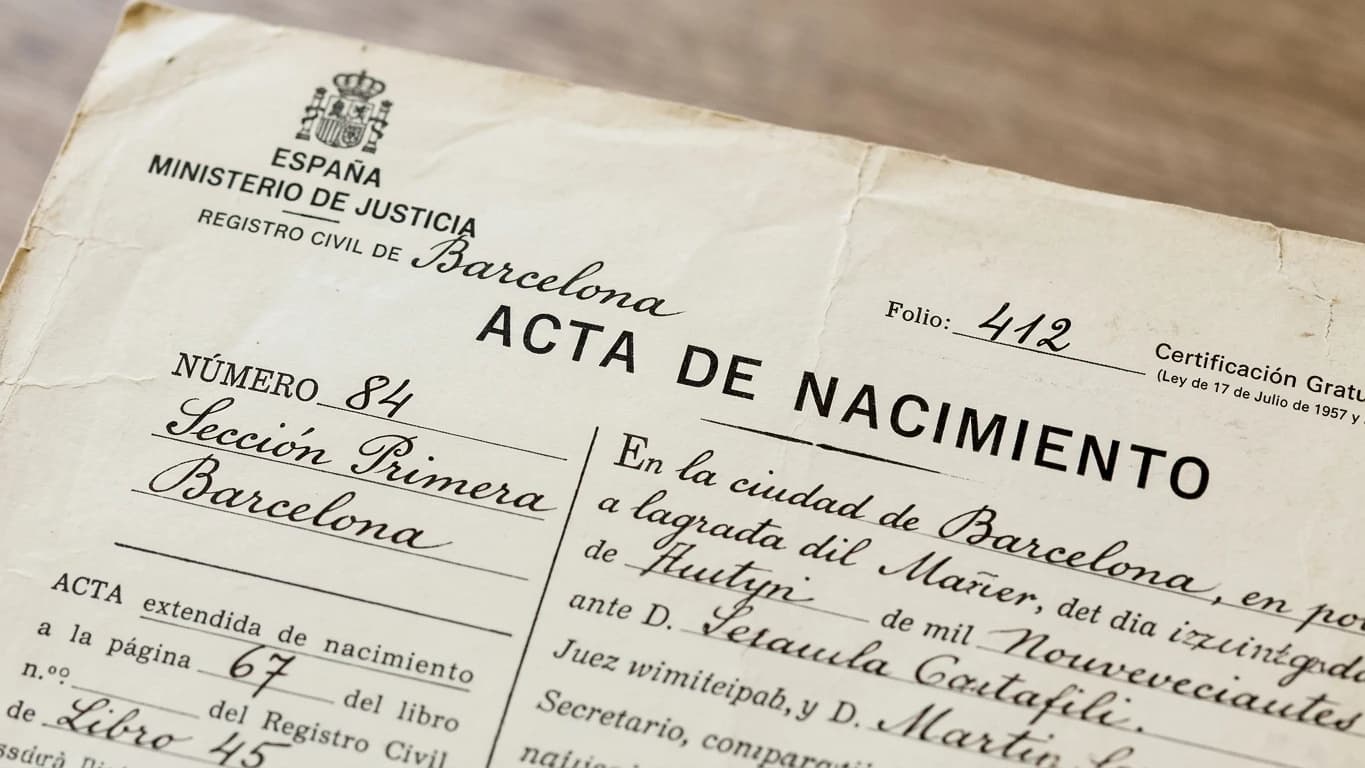
Your U.S. Birth Certificate Is Not a Spanish Birth Certificate: How Civil Status Paperwork Works for Americans in Spain in 2026
Spain's civil registry does not hold your American birth certificate. Until it is apostilled, translated and — if you want Spain itself to certify it — inscribed, every Spanish office that asks for it is entitled to reject it. And since 24 January 2026, the office that handles your file has changed.
🎂 Spain Does Not Have Your Birth Certificate
Here is the assumption that trips up almost every American who lands in Spain: that the civil registry in the country you now live in knows who you are and where you were born. It does not. Spain's Registro Civil is a Spanish institution. It records births, marriages and deaths that took place in Spanish territory, plus the births and marriages abroad that Spain needs for nationality and inheritance purposes. Your birth in Ohio, your marriage in Texas, your divorce in Florida — none of that is in it.
So every civil status document you will ever need in Spain is, at the start, a United States document. And a United States document does not simply walk into a Spanish office and work. It has to be authenticated, translated into Spanish by a person the Spanish state recognises, and — in the cases where Spain needs its own copy on file — formally inscribed into the Spanish registry. Skip a step and the office you are standing in will hand the file back.
The single most common rejection: an American walks into an Extranjería office with a photocopy of a U.S. birth certificate, no apostille and no translation. The officer is not being obstructive. The document has no evidentiary weight in Spain, so the file does not move.
The good news is that this system is older, cheaper and more predictable than it looks. Spain's Civil Registry Act — Ley 20/2011, of 21 July — has been in force for more than a decade, and the entire regime is free of charge. What changed recently is who handles your application, not what you have to produce.
🏛️ The Three Parts of One Registry
Article 10 of the Civil Registry Act is short and it dismantles a lot of confusion. The Registro Civil is institutionally one single registry. It is made up of the municipal registries, kept by the magistrate of the court of first instance assisted by the secretary; the consular registries, kept by Spanish consuls abroad; and the Registro Civil Central, which depends on the Ministry of Justice. There is a civil registry office in every Spanish consular district — 177 of them at present.
Which one touches your file depends on where you live now and where the event happened. A birth in Málaga is inscribed at the municipal registry of Málaga. A birth abroad of a person who later acquires Spanish nationality is inscribed at the Central registry in Madrid. A birth abroad of a Spanish national is inscribed at the Spanish consulate in the jurisdiction where it happened, with a duplicate going to Madrid.
Every certificate is free. Article 1 of Ley 25/1986, on the suppression of court fees, means the Spanish state charges nothing for civil registry work. Certificates are issued through the Ministry of Justice's electronic headquarters — sede.mjusticia.gob.es — and via the Cartera Ciudadana. If anyone quotes you a fee for obtaining a Spanish civil registry certificate, they are selling you a service, not the certificate.
Two technicalities catch people. First, under Article 82 you get an extract certificate by default — a summary of the data on file — unless you expressly ask for a literal certificate, which reproduces the entire entry. Most Spanish administrative procedures that involve a birth or marriage want the literal version. Second, Article 81 lets you request a bilingual certificate, and these are issued electronically by default. For anything that crosses a border, ask for the literal and ask for bilingual in the same request.
Action step: order the certificado literal, not the extract, and tick the bilingual option. If the certificate you already hold is an extract and the office demands a literal, you queue again. One request, right document, no second trip.
⚡ What Changed on 24 January 2026
If your file involves a foreign public document and you live in Spain, the office you go to changed this year. The Instrucción de 9 de enero de 2026, published in the BOE on 23 January and in force the following day, rewrote the competence rules for consular civil registry offices once the new digital system — DICIREG — was fully rolled out across all of them.
The substance is one sentence. As a general rule, the Registro Civil Central in Madrid now has competence to make the registrations based on foreign public documents of citizens resident in Spain. Consular offices keep that competence for residents of the country they serve. The general offices — the provincial ones — stopped processing these procedures entirely; they now act as a counter that forwards files to Madrid through the digital system.
Why this matters in practice: the consulates are now explicitly a "single window" for citizens — you can still turn up, still get served, and the file gets reassigned electronically to the office with competence. Nothing has been withdrawn. What has been withdrawn is the old informal practice of a consulate in Málaga or Miami deciding the merits of a file on a foreign document for a resident of Spain.
🔏 The Apostille: Who Signs It and What It Costs
Authentication is the part Americans get wrong most often, because the intuitive move — take the document to the U.S. Embassy in Madrid — is exactly the wrong move. U.S. embassies and consulates have no authority to affix an apostille. They say so themselves. The apostille is the exclusive competence of the authority of the country that issued the document.
Spain has been a party to the Hague Convention of 5 October 1961 since 25 September 1978. The United States acceded in December 1980 and the convention entered into force for it on 15 November 1981. There are 130 contracting parties. Both countries are in it, which means the full diplomatic legalisation chain — the embassy, then the foreign ministry — is obsolete between them. One stamp from the right American authority is enough.
Action step: order the certified copy from the vital records office of the state that issued it, not from the county where you happen to live. Then send it to that state's Secretary of State for the apostille. Keep the original in your hand from that point — an apostilled photocopy is worthless, and only originals or true copies from the issuing body are admissible.
🗣️ The Translation Is Not a Translation
An apostille proves a signature and a seal are genuine. It says nothing about what the document means. The Spanish state requires meaning to be transferred by somebody it recognises. Article 17 of Royal Decree 724/2020 establishes that translations made by sworn translators certified by the Ministry of Foreign Affairs are valid in Spain without any further legalisation, and Regulation (EU) 2016/1191 extends that recognition to sworn translations made by anyone qualified under the law of a member state.
"Certified translation" is not a magic phrase. A translation done by a bilingual friend, notarised in Texas, carries no weight. A translation by a sworn translator certified by the Ministry of Foreign Affairs does. Translations made by Spanish diplomatic or consular missions abroad are also official, but they must then pass through the Ministry's Legalisation Service — a step that adds time you can usually avoid.
What a compliant sworn translation looks like: it is a single undivided document covering the whole original, with a full copy of the original text attached, dated and stamped on every page, and the translator's certification of faithfulness and accuracy bearing a handwritten signature and a stamp. The pages of translation, certification and original copy must be stamped at the join so no page can be swapped. A machine translation with a translator's stamp stapled on the back will fail on the first inspection.
One shortcut is genuinely useful. Under the Vienna Convention of 8 September 1976, to which Spain is a party, a Spanish civil registry certificate issued in extract form can be produced as a multilingual certificate that is valid in the participating countries without legalisation or apostille. That is a solution for getting a Spanish document into the United States, not a U.S. document into Spain — but it means that if you are building a file that runs in both directions, ask for the multilingual extract as well as the literal certificate.
📅 The Six-Month Clock
Civil status documents expire. Not in law, but in practice, because offices want to be sure the data they are acting on is still current. When a Spanish consulate or a municipal registry is preparing a file — a marriage, a birth registration, a nationality record — it will ask for a birth certificate issued within the last six months. Several Spanish consulates state the six-month rule explicitly in their own published guidance.
The same logic runs through the residence file, with its own clocks. For a TIE renewal, the certificate of municipal registration — the certificado de empadronamiento — must be issued within the last three months, and the address printed on it must match the address you write on the application. A mismatch between the two is an automatic refusal or, at best, a delay.
Heads up: do not order a certificate the moment you think you might need it. Order it when you know the filing date. A birth certificate that sat in a drawer for four months is a birth certificate that has to be replaced.
💍 If You Married in Spain, You Are Already in the System
Here is a piece of good news that many Americans never discover. A marriage celebrated in Spain is inscribed in the municipal registry of the municipality where it took place — regardless of your nationality. If you married an American in Marbella, both of you are on file in the Spanish registry, and a certificado literal de matrimonio can be pulled from the Ministry of Justice's electronic headquarters in minutes at no cost. Religious marriages reach the register through a certificate issued by the minister of the denomination, under Article 63 of the Civil Code.
The mirror image is also true, and it is where the complications start. A marriage celebrated abroad between two Americans is not inscribed in Spain. There is no Spanish record of it. Spain will accept it for Spanish purposes — a spousal work permit, a family reunification file, a widow's pension claim — but only as a foreign document, and only once it has crossed the full chain: certified copy from the state, apostille from that state's Secretary of State, sworn translation into Spanish. And it still has to be within its freshness window.
There is one further wrinkle worth knowing. If you married abroad and one of you later acquires Spanish nationality, the marriage becomes registrable in the Central registry in Madrid, and from that point on Spain itself can certify it. That is a genuine advantage in a family file that has to run for decades.
👶 The CRBA Trap: Children Born Abroad
For a child born abroad to an American parent, the operative document is not a birth certificate but a Consular Report of Birth Abroad — the FS-240 — issued by a U.S. consulate. It records that the child acquired U.S. citizenship at birth. The State Department is emphatic that a CRBA is not a birth certificate, and Americans who treat it as one get stopped.
The application runs through the online eCRBA system on MyTravelGov, costs $100, and requires an in-person interview with the child present. Applications must be filed before the child's eighteenth birthday. Appointments are available in Madrid, Barcelona, Seville, Valencia, Mallorca, Las Palmas and Fuengirola — the U.S. Consular Agency in Fuengirola covers Málaga, Granada, Almería, the eastern part of Cádiz, Ceuta and Melilla, which is the whole Costa del Sol. Allow at least 72 hours between paying and booking.
Action step: if your child was born in Spain and you have never filed a CRBA, that file is on a deadline, not on a to-do list. It must be submitted before the child turns 18, and the Spanish-side birth record does not substitute for it — the two are separate claims in separate systems.
For the Spanish side of a child born in Spain, the picture is simpler. The birth is registered at the municipal registry of the municipality where the child was born, and where it is requested in time it can also be inscribed at the registry corresponding to the parents' domicile. Either way, the certificate is free and available through the same electronic headquarters.
📋 Where the Paperwork Actually Lands
Civil status documents are not a curiosity. They are the load-bearing wall of most Spanish administrative files, and the reason a missing apostille turns into a lost month. The table below is the mapping you will need most often as an American resident.
The renewal fee for a TIE is set by the 790 form, code 012: €19.30 for a renewal of a temporary residence permit, €16.08 for a first card, €21.87 for a long-term residence card, and €12.00 for a family member of a Spanish or EU citizen. Those are small sums. The expensive part is never the fee — it is the second trip because a document was rejected.
Watch the insurance, not the paperwork. For a non-lucrative residence renewal, private health insurance must carry no copay — a policy with a copay is refused outright — and must cover the entire period of the renewal, not merely the date of your appointment. It is the single most common reason a technically complete renewal file fails at the counter.
✅ The Sequence That Survives an Office
Follow this order and the file moves. Deviate from it and you will be back at the counter with the same document and a new set of instructions.
Pre-flight checklist:
- Identify the event and the country. Birth, marriage or death. Where it happened. That decides which registry holds it and therefore which office handles your file under the January 2026 rules.
- Check whether Spain already holds a record. Marriages celebrated in Spain and births in Spain are already registered. If the record exists, the certificate is free and immediate through sede.mjusticia.gob.es, and you skip the entire apostille chain.
- If the record is American, order a certified copy from the vital records custodian of the state that issued it, not from a county office. Order it close to your filing date, not months earlier.
- Apostille it at the Secretary of State of that same state. Not the embassy, not the county clerk. For a CRBA, the U.S. Department of State's Vital Records Office is the only option.
- Get a sworn translation from a translator certified by the Ministry of Foreign Affairs, as a single undivided document with the original stamped in on every page. Keep the apostilled original and the translation together, in one envelope, and never photocopy the apostille.
- Check the freshness clock for the specific filing. Six months for a civil registry file; three months for the municipal registration certificate; the address on that certificate must match your application exactly.
- File in the right place. Resident in Spain and filing on a foreign document — the Registro Civil Central in Madrid handles it. Resident abroad — the Spanish consulate. Get your Cl@ve or digital certificate sorted before you need it.
- Keep the whole chain in one folder, in order: original certified copy, apostille, sworn translation, plus the Spanish certificate where one exists. Inspectors work down the stack, and a missing intermediate page is a missing document.
❌ Five Mistakes That Cost a Month
1. Going to the embassy for an apostille. U.S. embassies and consulates have no apostille authority. They will tell you this, which is helpful, and then the file is still sitting on your desk without its stamp.
2. Using a notarised translation. A notary in the United States attests signatures. It does not certify linguistic accuracy in a way that satisfies Spanish law. The translator has to be a sworn translator the Spanish state recognises.
3. Filing at the consulate because it is round the corner. Under the January 2026 instruction, a consulate can still receive and route your file, but the decision on a foreign document for a resident of Spain sits with the Central registry in Madrid. Going local and hoping is not a strategy.
4. Asking for an extract when you need a literal. Extract certificates are the default under Article 82. Most Spanish procedures that involve a birth or a marriage require the full literal entry. Specify it, or order it twice.
5. Letting the certificate age. A birth certificate ordered on instinct and used eight months later is expired for registry purposes. Order against a date, not against a hope.
The structural point: none of this is bureaucracy for its own sake. It exists because Spain's registry is a legal instrument, not a database — a certification issued there constitutes full proof of the fact it records, and that proof travels across a border and into a court, a notarial deed or a benefit claim. The chain is what makes it hold.
Expatly360 handles apostilles, sworn translations, birth and marriage registration, NIE and TIE filings, and the document chain that connects American civil records to Spanish administrative files. We coordinate the sequence with the registry, the consulate and your notary so the paper arrives complete and in the form the counter will actually accept. First consultation is free.
Expatly360 helps Americans on every step of the civil status paperwork Spain demands
📞 +34 673491330 | WhatsApp available
🌐 www.expatly360.com
Recommended for You

Relocating to Spain?
Don't navigate the bureaucracy alone. Our team in Malaga handles everything from NIE to residency permits.
Get Professional Support