
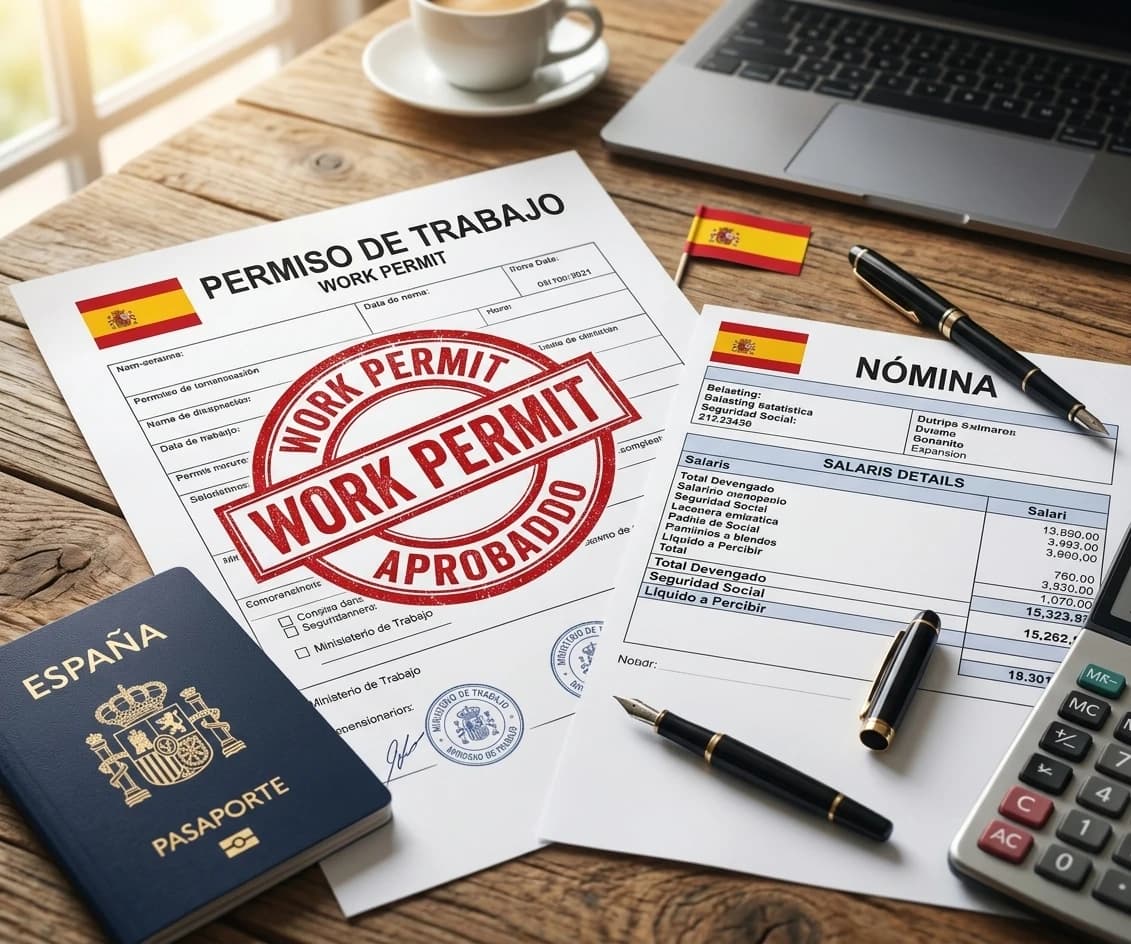
Working in Spain as an American in 2026: The Work Permit, the Payslip, and What Actually Lands in Your Account
Two Americans accept the same offer in Málaga at €2,500 a month, and both end up roughly a thousand euros poorer than they expected. One filed the work permit properly, knows what the collective agreement guarantees, and reads the retention line on the first payslip. The other signed a contract, opened a bank account, and met the tax office in March. Spain does not punish foreign hires for being foreign. It punishes the uninformed, in euros, on a schedule.
💼 The work permit is your employer's job, not yours
If you are being hired as an employee in Spain, you do not apply for the work permit. Your employer does. This is the first thing American hires get wrong, and it is a mistake worth an entire quarter of unpaid work: they wait for a permit that their own company was supposed to file three months earlier.
The instrument is the autorización inicial de residencia temporal y trabajo por cuenta ajena, created by Article 73 of the Reglamento de Extranjería (Real Decreto 1155/2024, in force since 20 May 2025). The employer files electronically through the Ministry's Mercurio platform, pays the work-authorisation fee, and only then do you enter the country — or, if you are already here legally, obtain the authorisation that lets you be employed.
Three details in that Article catch most people:
First, the permit is narrow on purpose. An initial authorisation lasts a maximum of one year and is limited to one occupation and one autonomous community. You cannot move to a different job in a different region on it. That restriction lifts on renewal.
Second, the renewal is the prize. A renewed residence-and-work authorisation runs four years, removes both the occupation and the geographic limit, and lets you work on an employee basis, a self-employed basis, or both at once. Plan the first eighteen months around the fact that you will eventually want that.
Third, there is a two-clock deadline. You must be registered with Social Security within three months of entering Spain legally, and you must apply for your TIE card yourself within one month of that registration — in person, at the police. Miss the second one and you are working on an expired card.
There is a parallel path worth knowing about. A job-seeker visa, created in the same 2024 regulation, lets certain nationals reside in Spain for twelve months while they interview and apply. It is not a work permit, and consular applications in 2026 are limited to specific profiles. The Reloex also cut the continuous-residence requirement for arraigo from three years to two, which matters if you arrived on a student or tourist status and are already counting months.
📋 What has to be true before the permit exists
The employer carries the legal burden, and the file dies in predictable places. First, the national employment situation must permit the hire. The occupation must appear on the catalogue of hard-to-cover jobs that the public employment service publishes quarterly, or the employer must demonstrate that the vacancy is genuinely hard to fill domestically — which means posting the vacancy on Empléate and obtaining a report from the public employment service on the urgency of the hire. Nationals of Chile and Peru are exempt from this test entirely because of bilateral agreements with Spain.
Second, the employer must show solvency: the company's tax identification number and either the last corporate income tax declaration or an income certificate. Third, there must be a signed employment contract on the official model, guaranteeing the worker a minimum of continuous activity. And fourth, the file must include police record certificates from Spain and from every country where you have lived in the past five years, plus a medical certificate.
Heads up: any document coming from outside Spain needs a sworn translation into Spanish by a traductor jurado and a legalisation by the Spanish consulate, unless it carries an apostille under the Hague Convention of 5 October 1961. A US birth certificate or degree that arrives unapostilled is a file that comes back. Get the apostille before the employer submits, not after.
One more thing worth knowing, because recruiters are often asked about it and rarely explain it: while your initial permit is active, it also authorises you to run a self-employed activity in parallel, provided the employment is your main activity. If that employment ends abruptly for reasons outside your control, you must tell the Foreigners' Office within three days. Set up the autónomo paperwork while you still have the paperwork-free window.
⏱️ Three months, one visa, and the fee that is not yours
The administration has three months from the filing date to resolve the authorisation, and if it says nothing the application is treated as refused. Silence in Spain is a decision, and it is a decision against you. This is why a file submitted with an unapostilled certificate is not a delay. It is a refusal waiting for the third month to expire.
The fees are fixed and public, and the split matters. The residence authorisation fee is yours. The work authorisation fee is the employer's, and the law goes out of its way to say so: any agreement under which an employee assumes all or part of that cost is void. If a recruiter in Málaga asks you to cover €407.71 for the work permit, that is not a favour being offered to you. It is a claim they have no right to make.
Action step: your first payslip is the document that proves the whole chain exists. No Social Security registration means no payroll, and no payroll means no lawful work. If three weeks after your start date you have no nómina, ask your employer for the alta certificate before you ask for anything else.
📑 The contract is not your salary — the collective agreement is
Spain has no statutory salary for a job title. Ask two recruiters for "a marketing manager in Málaga" and you will get two numbers and neither of them is a legal floor. The binding figure sits in the convenio colectivo — the collective agreement for your sector, and often for your province — which sets salary tables by professional group. Since 5 October 2026, under Real Decreto 723/2026, the employer is obliged to hand you detailed information about the agreement that governs your employment. The law stopped treating it as internal company business.
The floor underneath all of it is the interprofessional minimum wage. For 2026 it is €1,221 gross a month across fourteen payments, or €17,094 a year, a 3.1% rise set by Real Decreto 126/2026 and applied retroactively from 1 January 2026. If a contract pays you less, the difference is owed to you with arrears, and the claim is yours to make, not the employer's to volunteer.
Which brings the sleight of hand. Article 27 of the Workers' Statute allows absorption and compensation: if your total professional salary — salary plus supplements — already exceeds the new minimum, the employer owes no increase at all. The 2026 decree left that mechanism untouched, despite considerable noise about scrapping it. Your €1,184 from 2025 can be the same €1,184 in 2026 if it sits inside a package that clears the new threshold. Read the total, not the headline.
A salary below the collective agreement is not a negotiation. It is a debt, and you can claim the difference for up to a year back. Ask for the convenio, find your professional group in the salary table, and compare. Recruiters who flinch at that question are telling you something useful.
💸 Your first payslip: three deductions, one of them negotiable
A gross salary in Spain is not a salary. Three things come off it, and only two of them are fixed. The most confusing is the one everybody thinks is negotiable and is not: income tax withholding is computed by an algorithm the tax agency publishes, run against your declared family situation, and it is an advance on a final bill, not the bill.
Social Security for 2026 is set by Orden PJC/297/2026. Your employee contribution is 6.50% of your contribution base on a permanent contract, and 6.55% on a fixed-term one. Your employer's contribution is roughly 30.65% before accident and occupational disease premiums, which vary by activity and can add a further 1.5% or more. The employer also owes the social-security contribution on your behalf, which is why your gross number on paper is not what the company spends to employ you.
The contribution base is capped at €5,101.20 a month in 2026, and the minimum bases run from €1,424.40 for administrative and support roles up to €1,989.30 for engineers and senior management. One 2026 change to watch: contracts of fewer than thirty days now attract an additional €33.62 employer contribution. Short-term hiring looks cheap until it is priced.
Income tax withholding follows a separate scale. The tax agency publishes the brackets; the individual percentage comes out of the algorithm, which takes your family situation into account and produced new versions during 2026, the most recent taking effect on 10 September. The brackets for the Costa del Sol run from 19% to 47% once the state and Andalusian regional scales are combined.
🧮 The arithmetic: €2,500 a month, fourteen payments
Take the common case: €2,500 gross a month across fourteen payments, €35,000 a year, a permanent contract, no other income and no children. Social Security contributions are paid on a base annualised over twelve months, which puts the base at €30,000 and your 6.50% at €1,950. After the standard €4,000 of deductible employment costs, the taxable base lands at €29,050.
Apply the state scale and the Andalusian scale to that base and the tax comes to €3,440.25 plus €3,399.50, or €6,839.75 — an effective 23.54% of the base. Subtract the social-security contribution and the tax from gross and roughly €26,210 remains before the personal and family minimums are applied. The employee pays about €8,790 of a €35,000 package in tax and contributions. The employer, meanwhile, has added roughly €9,195 of its own. That is the real cost of the job, and it is why the gross number on the offer is the least interesting number in the conversation.
Action step: compare the offer against the collective agreement table before you sign, and ask whether the fourteen payments include extras. Two employers offering €2,500 a month can differ by more than €4,000 a year once you count twelve versus fourteen payments and the supplements that get absorbed into the minimum wage.
⚖️ The 2026 exemption most people miss
Real Decreto-ley 5/2026, published on 19 February 2026, created a deduction that keeps the lowest earners out of the income tax system entirely: €590.89 a year for anyone whose employment income is at or below €17,094. Above that, the deduction falls by twenty cents for every euro earned, and it disappears entirely at €20,048.45. It applies to people with no other non-exempt income above €6,500.
So a worker on the 2026 minimum wage pays zero income tax in the annual return — but the withholding still leaves the payroll every month. The money comes back at the declaration, provided you file one. And here is the trap: the moment you add rental income, freelance invoices or investment income above €6,500, the deduction disappears and you pay the full bill. Americans who take a flat in Málaga to rent out on Airbnb do not realise they have just traded a €590.89 exemption for a tax liability running into thousands.
Two separate thresholds, often confused. Below €15,876 of gross employment income from a single payer — rising with children, or with a spouse who earns under €1,500, up to €19,262 — your employer withholds nothing at all. Separately, you must file an annual return if your employment income exceeds €22,000 from one payer, or €15,876 if a second employer paid you more than €1,500. One governs what is withheld, the other governs what you must declare. Know which one you are reading.
🎯 Five ways Americans lose a year in Spain
Pre-flight checklist:
- Get the employer's filing confirmed in writing. Reference number, date, and the name of the company that filed it. If you are not being paid through Social Security, you are working illegally, whatever the contract says.
- Apostille everything, early. Police records, degrees, marriage certificates. A document without the apostille and sworn translation stops the file and turns a three-month wait into a refusal.
- Ask for the convenio and find your professional group. Then check the offer against the table. A salary below the agreement is a claim you can bring for up to a year of back pay.
- Read the first payslip line by line. Social-security base, contribution percentage, income-tax retention rate, and the number of payments. If the retention rate does not match your family situation, correct it on form 145 — it is a formality, not a negotiation.
- Calendar the two deadlines. TIE application within one month of the Social Security alta. Renewal filing two months before the permit expires — file in time and the old authorisation stays valid while they process it; file late and it becomes a fine of up to €500.
- Run the numbers on everything you earn. Before you sign a lease you intend to rent out, or invoice a client from your first freelance client, confirm the extra income does not push you past the €6,500 ceiling that voids the low-earner deduction.
None of this is hostility to the foreigner. Every rule above applies identically to a Spanish citizen hired in Cádiz. What makes it feel targeted is that the paperwork is written for people who grew up inside it, and the Americans who arrive here often arrive from systems where a contract and a bank account were sufficient. They are not sufficient. The permit is filed by the employer, the salary floor sits in a collective agreement published in the gazette, and the tax arrives with a schedule of its own.
The Americans who thrive here are the ones who stop treating the Spanish system as bureaucracy to be survived and start reading it as the actual terms of the job. The contract is not the salary. The gross salary is not the salary. The permit is not your paperwork. Once those three things are understood, working in Spain stops being expensive and starts being ordinary, which is the only way it was ever going to be.
Expatly360 handles NIE applications, TIE renewals, work-permit paperwork, and the full relocation sequence for American families moving to Spain. We coordinate the employer filings, the Social Security alta, the apostilled documents and the tax registrations so the first payslip arrives clean and the renewal never surprises you. First consultation is free.
Expatly360 helps Americans on every step of working in Spain
📞 +34 673491330 | WhatsApp available
🌐 www.expatly360.com
Recommended for You


Relocating to Spain?
Don't navigate the bureaucracy alone. Our team in Malaga handles everything from NIE to residency permits.
Get Professional Support