
How to Shop at a Spanish Local Market as an American Expat: The 2026 Hours, Prices, Phrases, and Labels
🛒 The two market models you will actually use
Spain runs two distinct market formats and the rules differ in each. Knowing which one you are standing in is the difference between buying dinner and getting politely turned away.
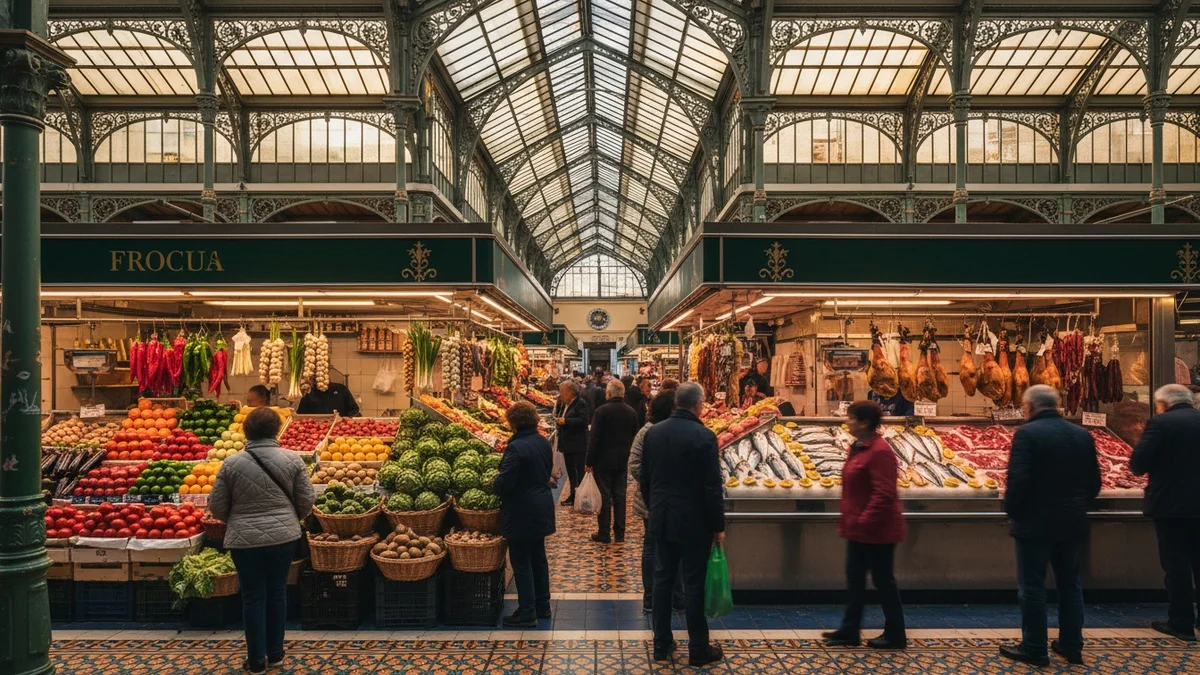
The first is the municipal food market — the *mercado municipal* or *mercat* in Catalan — a permanent covered hall run by the local town hall, with individual stalls (*paradas*) leased to fishmongers, butchers, greengrocers, cheese and cured-meat vendors, spice stalls, and dry-goods sellers. Barcelona's La Boqueria on La Rambla is the most famous example, with 200+ comerciantes and a 1836 founding date. The municipal model is a neighbourhood institution: regulars shop there three to five times a week, the stallholders remember names, and pricing is by kilogram on handwritten cards.
The second is the gastronomic / gourmet market — the *mercado gastronómico* — a converted or purpose-built hall of small tapas counters and ready-to-eat stalls. Madrid's Mercado de San Miguel is the model: 10:00 to midnight Sunday through Thursday, to 01:00 Friday and Saturday, with prices per tapa, per *ración* (portion), or per 100 g, not per kilo. Tourists shop here; locals shop for one event, not for the week.
⏰ Hours, closures, and the pre-dawn wholesale clock that makes the fish fresh
Spanish municipal markets are not 24/7, not even close. The 2026 baseline is Monday through Saturday, roughly 8:00 to 14:30 for the morning trading session, and many reopen from 17:00 to 20:00 for an evening session. La Boqueria publishes the wider window: Monday to Saturday 8:00 to 20:30, with the information desk open 9:00 to 15:00. Almost every municipal market is closed on Sunday and on a handful of public holidays — the specific holiday list varies by autonomous community, so check your city hall's market page before planning a Sunday shop.
The reason the morning fish is genuinely fresh — not "fresh-ish" — is the upstream wholesale network run by Mercasa, the state-owned food-chain information company. Mercasa operates the "Red de Mercas," a network of 24 wholesale units covering more than 7.9 million square metres. The fish wholesalers in that network, including the Mercat del Peix at Mercavalencia (Tuesday to Saturday 3:45 to 8:00), unload and auction product in the small hours. The retail *parada* in your municipal market was restocked from that wholesale auction 4 to 8 hours before you walk in.
⚖️ Prices are per kilogram. Forget the pound.
Spain is metric, end of discussion. There is no exception at the market, in the supermarket, or in the recipe. Every price card, label, or board at a market *parada* is in €/kilogram for fresh produce, fish, and meat. That rule has legal teeth: Royal Decree 3423/2000 of 15 December 2000 transposes EU consumer-price-indication rules into Spanish law, and the national enforcement is run by the autonomous-community consumer authorities. For loose, non-prepacked food — the apples, the tomatoes, the cut of pork on the butcher's block — the legally required unit of measure is the kilogram, and the displayed price is the price per kilogram.
American expats who try to convert on the fly make three errors. They under-buy by treating €/kg as €/lb, they ask for "half a pound" in a unit nobody in the building can weigh, and they over-tip the stallholder because they think the bill is too low. The fix is mechanical: 1 lb = 0.453 kg. When the card says €4.50/kg, €2.04 is the price for one pound, and €2.27 is the price for half a kilogram. A small kitchen scale — €8 to €15 at any Ferretería or Lidl — pays for itself in one week of fish shopping.
The phrases you actually need at the counter, in the order you need them, are short. Most stallholders in tourist-heavy markets speak enough English to bridge a misunderstanding, but using the Spanish unit earns the relationship — and the relationship is the whole point of a municipal market.
🐟 Fish labels: the legal floor for what the stall must tell you
Spain is the EU's second-largest consumer of seafood per capita and the busiest fish counter in any given municipal market is the most important stall to learn. There is a specific legal floor for what the fishmonger must tell you, and the floor is higher than the small handwritten card on the ice usually suggests.
Under EU Regulation 1379/2013 on the common organisation of the markets in fishery and aquaculture products, mandatory consumer information for fresh fish sold over the counter includes the commercial designation of the species (the official Spanish name, which is not always what is on the card — "bacalao" is the protected name for true cod), the catch area (FAO fishing zone or country for farmed product), and the production method (caught at sea, caught in inland waters, or farmed). Spain enforces this through AESAN, the Agencia Española de Seguridad Alimentaria y Nutrición, part of the Ministry of Consumer Affairs. AESAN's labelling portal is the official national reference.
The European Commission's pocket guide for the new fish and aquaculture consumer labels is the single best one-page summary of what each code on the label means. It is published by DG MARE as a PDF and it is the document to keep on your phone for the first six months of shopping.
Two practical rules of thumb. First, the price-per-kilogram gap between farmed and wild sea bass (*lubina*) and gilthead bream (*dorada*) is roughly 40 to 60% — know which one you are buying. Second, the day's freshest catch is what was unloaded from the Merca wholesale auction 4 to 8 hours earlier. If the ice under the fish is melting and the eyes are still clear, you are looking at that morning's delivery. If the eyes are cloudy and the gills are dull, walk to the next stall.
🧀 Cheese, ham, and the EU labelling floor for everything else
For prepackaged food — wheels of cheese, vacuum-packed jamón, jars of olives, conservas, spice bags — the binding rule is EU Regulation 1169/2011, the Food Information to Consumers (FIC) regulation, in force since 13 December 2014. The stallholder must provide, on the label or in writing on request, the name of the food, the ingredients list in descending order of weight, the 14 named allergens, the net quantity, the nutrition declaration, the country of origin where required, and the use-by / best-before date. AESAN is again the national enforcement body.
The 14 allergens every expat with a dietary restriction needs to memorise are: cereals containing gluten, crustaceans, eggs, fish, peanuts, soybeans, milk, nuts, celery, mustard, sesame seeds, sulphites, lupin, and molluscs. If a *tabla* of cheeses does not arrive with a label, ask for the FIC information sheet — Spanish law requires the trader to have it on hand. A refusable answer is a signal to find a different stallholder.
For the cured meats Spain is famous for — jamón ibérico, jamón serrano, lomo, chorizo, salchichón — the rule of thumb is to buy a 100 g cut for a tasting (*"cien gramos para probar"*) and only commit to a larger cut (*medio kilo, por favor*) once you have confirmed the flavour and the stall's rotation speed. Iberian acorn-fed jamón (the *bellota* grade) is roughly three to four times the price per kilo of standard serrano; the difference is real, but only worth paying once you know the cut you prefer.
🍅 Seasonality: the official Mercasa calendar and what it actually means for late July
Mercasa publishes a weekly recommended seasonal produce list under the heading "Frescos y de temporada" — the closest thing Spain has to an official retail calendar. For the week of 27 July 2026, the list is heavy on Mediterranean summer fruit and vegetables: tomato (the *raf* and *de Penedès* varieties are at peak), peppers, aubergine, courgette, onion, garlic, stone fruit (peach, nectarine, apricot), fig, watermelon, and melon. Fish-wise, the late-July list is dominated by dorade, sea bass, sardine, tuna, and mackerel.
The single most useful thing the Mercasa list does is name the in-season items in the current week. That solves the "what is local right now" question that American expats default to the supermarket for. If the Mercasa weekly list names it, every municipal-market greengrocer will have it at the lowest price of the year, sourced from the same national supply chain that supplies the wholesale Merca network. If the Mercasa list does not name it, you are paying for import or greenhouse production — and the cost difference is visible on the price card.
Trust the stallholder above the calendar when they conflict. A municipal-market greengrocer who has worked the same stall for twenty years knows the micro-seasonality of the surrounding province better than the national Mercasa list. Ask "¿Qué es de aquí ahora?" (what is from here right now?) — the answer is the closest, freshest, and usually the cheapest option in the building.
💳 Payment, bags, and the four things American expats get wrong at the counter
Spain is a card economy. The Banco de España's retail payments data show cashless transactions surpassed cash in volume terms by 2022, and contactless is the default at every major chain. Most municipal-market stalls now accept debit and credit cards via portable terminals, and many accept Bizum, the instant Spanish mobile-payment app, by phone number. The exception is the smallest stalls in the oldest markets — cash is still useful for tickets under €5.
The four errors American expats make most often at the counter, in the order they cost the most money and goodwill:
- Asking for half a pound. Spain is metric. The scale is metric. Nobody in the building can legally weigh an imperial unit. Ask in kilos or in the unit the stallholder is using. If the price is per kilo and you want a pound's worth, ask for "doscientos gramos" (200 g) and round up to 250 g ("un cuarto") if you are unsure.
- Skipping the bag. Many stalls hand you produce directly and expect you to bring a bag. Carry a foldable cloth bag in your daypack — the kind sold at any Chinese bazaar or Lidl for €2. You will need it at the produce, fish, and butcher counters. The market will not provide one for free.
- Tipping the stallholder. Tipping is not a market custom. The price on the card is the price. A "gracias" and a return visit is the relationship. Save the tip for the waiter at the bar across the street.
- Treating the stall like a self-service counter. The stallholder chooses the cut, the weight, and the wrap. Point, ask, and wait. Touching the produce or the fish is not the local custom; if you want to inspect, ask first. The exception is the loose-produce section of large greengrocer stalls, where you bag your own tomatoes into a plastic basket and present them to be weighed.
📋 The first-week checklist: what to buy, where, and in what order
The first week at a Spanish market is a learning loop. Plan the loop in four passes, in this order, to avoid the most common rookie pattern of buying impulsively on the first stall and then realising you bought twice the cheese and no vegetables.
- Pass 1 (08:00 – 09:30, Tuesday): reconnaissance. Walk the entire market once without buying. Note which stalls are busy, which are empty, which have the longest queues. Identify the fishmonger, the greengrocer, the cheese stall, the bread stall, the dry-cured-meat stall. Buy one small item — a piece of fruit, a single cut of cheese — to anchor the first relationship.
- Pass 2 (08:30 – 10:30, Thursday): the protein shop. Buy fish at the busiest fishmonger (queue length = quality signal). Buy cured meats and cheese at the busiest cheese stall. Note the price per kilo, the cut you preferred, and the stallholder's name.
- Pass 3 (10:00 – 12:00, Saturday): the produce shop. Hit the greengrocer for the weekly basket — tomatoes, peppers, onions, garlic, seasonal fruit. Bring a cloth bag. Build the basket list off the Mercasa "Frescos y de temporada" page for the current week.
- Pass 4 (any weekday after Pass 3): dry goods, bread, and household. The bakery stall for the daily bread (most Spanish households buy bread daily, never in slices, never pre-bagged). Olive oil, salt, conservas, spices, and household staples are at the dry-goods stalls and are often the same price as Mercadona.
By the end of the first month, the basket will weigh roughly 60% produce, 25% protein, and 15% dry goods and bread. The cost per week for one person runs €45 to €75 depending on the city — cheaper in smaller provincial markets, more expensive in central Madrid and Barcelona. A Spanish market shop is consistently 10 to 20% cheaper per kilogram than the equivalent Mercadona or Carrefour basket for fresh produce, and is the only place to buy the specific cuts of fish and the specific cheese and ham varieties that Spanish cooking assumes.
Two final pieces of advice. First, the municipal market is the closest thing Spain has to a civic institution. Treat it like one. Do not bargain, do not take photos of the stallholders without asking, do not block the counter while reading this article on your phone. Second, the rules above apply in every autonomous community — Catalonia, Andalusia, Madrid, Valencia, the Basque Country, the Canaries — with small local variations in dialect and stall type. The legal floor (€/kg, EU 1169/2011, EU 1379/2013 for fish) is national. The Mercasa "Frescos y de temporada" list is national. The municipal-market model is national. Once you understand the model, the rest is local colour.
Expatly360 handles NIE applications, TIE renewals, and the full relocation sequence for American families moving to Spain, including the practical onboarding that has nothing to do with paperwork — which market to anchor in your new neighbourhood, which stallholder to introduce yourself to in week one, and which municipal-market rhythm to adopt. First consultation is free.
📞 +34 673491330 | WhatsApp available
🌐 www.expatly360.com
Recommended for You

Relocating to Spain?
Don't navigate the bureaucracy alone. Our team in Malaga handles everything from NIE to residency permits.
Get Professional Support