International Schooling in Andalusia for Expat Families: The 2026 Reality Check on Curriculum, Cost, and Catchment<
🎒 Four school tiers, one decision
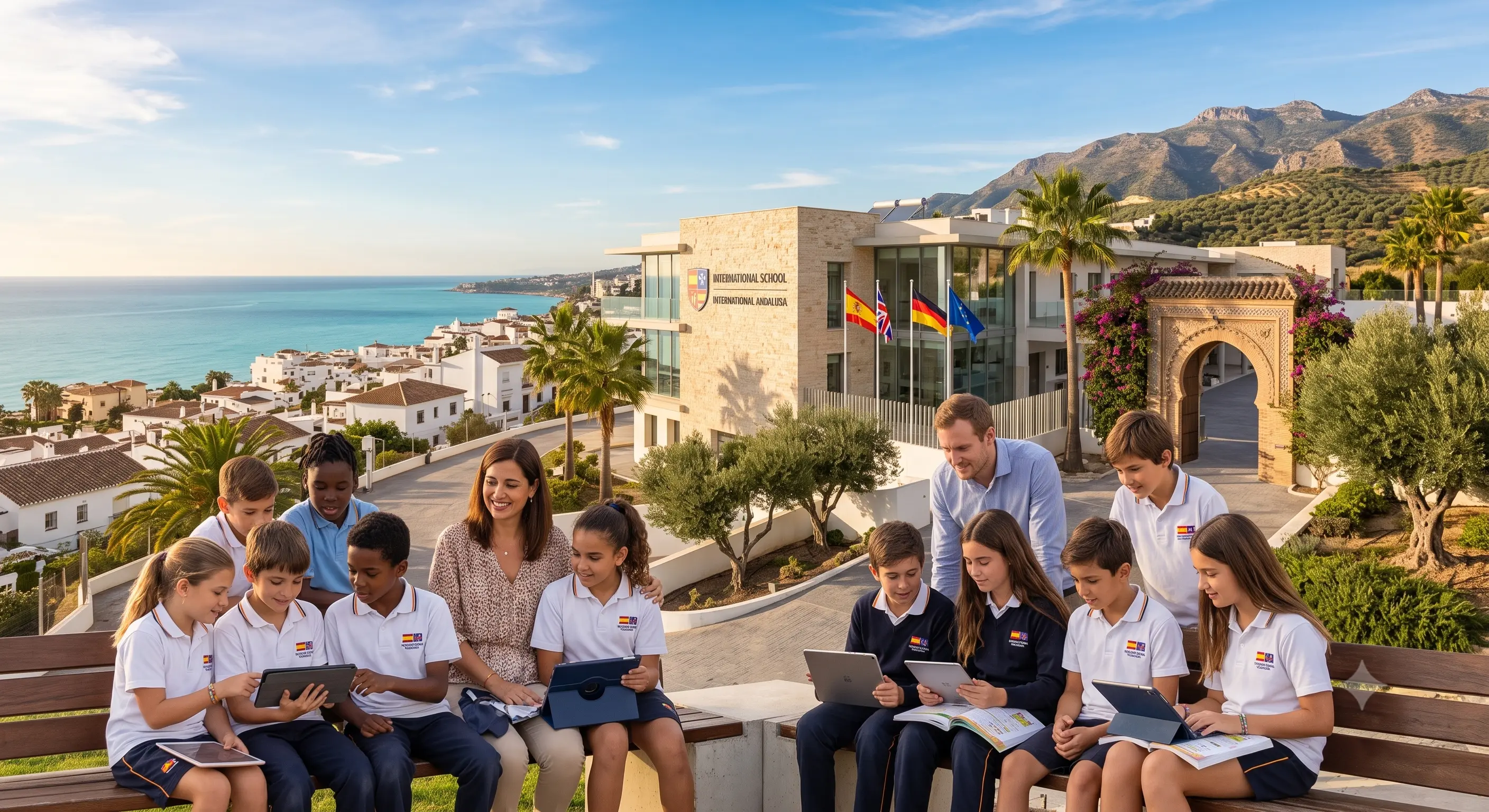
Andalusia runs roughly 7,200 schools for 1.9 million pupils. For expat families, only four tiers matter — and each carries a different cost, language exposure, and waiting list. The mistake most newcomers make is treating "Spanish school" as a single category. It is not.
Public (público) — free, Spanish-only, locals first
Municipal colegios públicos and institutos are free, including textbooks under the Junta de Andalucía's gratuidad programme. Enrolment runs March-to-April for September. Catchment is strict: local siblings first, then walking-distance addresses, then the rest of the municipality. Instruction is 100% Spanish in primary, with English as a subject from age 6. Functional for under-10s who pick up languages fast. Brutal for a 14-year-old dropped in mid-year.
Concertado — semi-private, Catholic, affordable
Mostly church-run schools funded by the Junta plus monthly fees of €30–€120. Religion class is on the curriculum (optional opt-out since 2022 reforms). Spanish-medium. Used by Andalusian middle-class families who want smaller class sizes than public but cannot afford international tuition. Roughly 30% of Andalusian pupils attend concertado.
Private national — Spanish-medium, premium service
Fully private Spanish schools like CEU San Pablo or Centro Educativo Remedios (both Sevilla) charge €400–€900/month for enhanced facilities, bilingual tracks, and university-prep tutoring. Curriculum is Spanish LOMLOE. Useful for expat families planning long-term Spain residency who want Spanish fluency at native-speaker pace.
International — the expat default
English-, German-, French-, or IB-medium schools. Andalusia hosts 88 officially recognised international and bilingual centres as of 2026, up from 71 in 2022. Costa del Sol alone accounts for 41 of them, driven by British, German, and Nordic resident demand. This is the tier most expat families end up in — and the one with the longest waiting lists.
🌍 Curriculum options — British, American, German, French, IB
Five curricula operate on the ground in Andalusia. The choice is dictated by the family's long-term plan, not by the school's marketing.
📍 Catchment by region — Costa del Sol vs Sevilla vs Granada vs Cadiz
Where you live determines which schools you can reach without a 45-minute drive. The four expat-relevant hubs have distinct profiles, and the wrong match means a daily school run that eats two hours and €400/month in fuel.
📄 Documents the school will actually ask for
Every international school in Andalusia runs a near-identical admissions checklist. Most rejections come from missing paperwork, not from capacity. Bring:
- NIE or TIE — the foreigner's tax/residency number. Apply at the Oficina de Extranjería in Málaga, Sevilla, or Granada before school enrolment. Processing is 4–6 weeks.
- Empadronamiento — municipal registration at your local ayuntamiento. Proves the catchment address. Without it, public school placement is rejected outright.
- Vaccination card (cartilla de vacunación) — translated to Spanish by a sworn translator (traductor jurado). The Andalusian health service (SAS) issues the equivalent locally within 48 hours of empadronamiento.
- Previous school records — last two academic years, translated and apostilled under the 1961 Hague Convention. UK post-Brexit records still require apostille, not legalisation.
- Passport copies for both parents and child, plus family book (libro de familia) if available.
- Medical certificate for Year 7+ entry in some British-curriculum schools — standard paediatric clearance.
💶 Junta de Andalucía subsidies — what is actually free
Public schooling in Andalusia is free, including textbooks under the Programa de Gratuidad de Libros de Texto. The Junta also runs:
- School transport (transporte escolar) — free for pupils living more than 2 km from their assigned centre. Mostly relevant in rural municipalities.
- School meal grants (ayudas de comedor) — €4–€6 per day subsidy for low-income families, applied for in June for the next academic year.
- Bilingual section bonuses (auxiliares de conversación) — funded by the Ministry of Education, not the family, but they reduce class size in bilingual public schools.
- Scholarship for international-exam fees — Junta-funded subsidies cover IB exam fees (~€850 per subject) for low-income Spanish-resident families at public centres. Not available to international private school pupils.
International schools are not eligible for these subsidies. The savings are a public-school-only benefit, and they are real — a Spanish-medium public school with free textbooks, transport, and meals costs roughly €0–€300/year per child in incidentals. The catch is the language of instruction.
⚠️ The real challenges nobody puts in the brochure
Three failure modes hit 60% of newly-arrived expat families in their first academic year. They are avoidable with planning, brutal without it.
The waiting list
British School Málaga Year 7 currently sits at 11 months for non-sibling applications. Aloha College Marbella IB DP cohort has 18-month lead times for 2027 entry. Apply on the day you sign the rental contract — not the day the family arrives.
The calendar mismatch
Andalusian school year runs September 10 to June 25, with a two-week Semana Santa (Holy Week) Easter break that shifts annually between late March and mid-April. UK and German school holidays fall on different weeks. Families splitting time across two countries pay for the missed days in one system. British international schools honour a UK-style Christmas break (2 weeks) that public Spanish schools do not.
Social integration
International schools in Andalusia enrol 60–80% non-Spanish pupils. Children learn English as the lingua franca but rarely pick up fluent Spanish unless placed in an after-school clase de español or a weekend deporte club. Parents who arrive expecting bilingualism by year two are usually disappointed by year two and realistic by year four. Hire a Spanish tutor at €18–€25/hour from week one.
🎯 The closing case
International schooling in Andalusia in 2026 is well-developed, well-priced relative to Dubai or London, and overloaded on the Costa del Sol. The families who win the transition apply six months early, choose the curriculum that matches their next country, and treat the school search as a logistics project — not a wish list. The families who lose arrive in July, tour three schools, and accept whatever has a September seat left.
The cost spread is real: a French Lycée track at €4,800–€7,200/year is roughly a third of the IB DP option at €18,500. The Spanish public option at €0–€300/year is cheaper still — but only if the family has accepted a Spanish-medium future. For expat families with a 3-to-5-year horizon, the British or IB track on the Costa del Sol remains the rational default. For families staying longer and committed to Spanish fluency, the public route, paired with private Spanish tutoring, runs €3,000–€5,000/year total and produces fluent Spanish within three years.
The choice is not about money. It is about what language the child will dream in five years from now.
Expatly360 handles school search coordination, document apostille, and Junta de Andalucía subsidy applications for expat families. First consultation is free.
Expatly360 helps expat families on every step of schooling in Andalusia
📞 +34 673491330 | WhatsApp available
🌐 www.expatly360.com
Recommended for You


Relocating to Spain?
Don't navigate the bureaucracy alone. Our team in Malaga handles everything from NIE to residency permits.
Get Professional Support